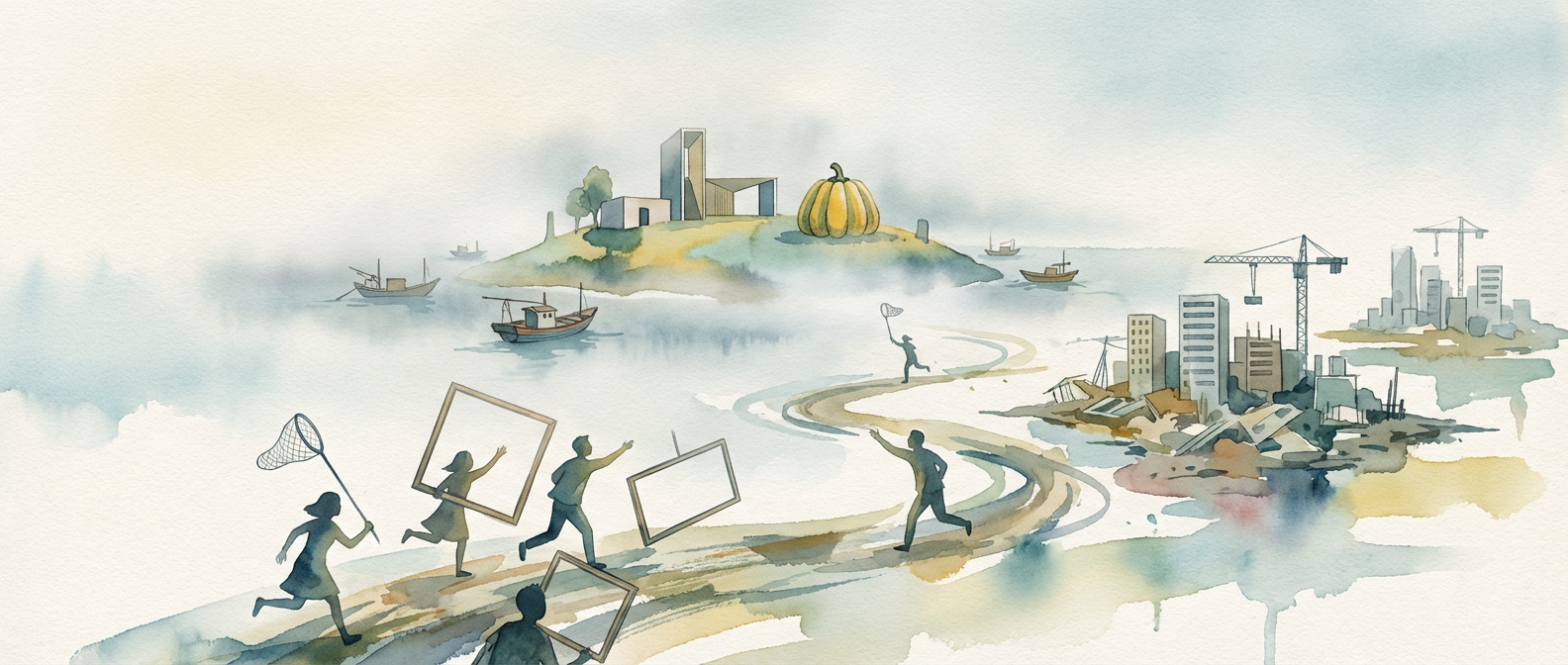
The Island That Broke the Rules
There’s this thing happening right now where cities are basically speed-running the Naoshima playbook, and I get it. Last year alone, 780,000 people made the pilgrimage to this small island in Japan’s Seto Inland Sea. That’s not a typo. A place that was quiet enough to hear the ferry horn clearly a few decades ago is now moving visitor numbers most theme parks would celebrate. Everyone from Detroit to Marseille to Gwangju has looked at those numbers and thought: we need that energy. We need to be the next Naoshima.

The problem is that at least a dozen cities have already launched formal “art island” initiatives in the last couple of years, and most of them are copying the Instagram aesthetic while completely missing the actual infrastructure that makes Naoshima work. It’s like watching people recreate the look of a thriving neighborhood coffee culture without understanding that it only exists because of a specific landlord’s 15-year lease strategy and three baristas who actually live nearby.
I’ve been thinking about this a lot, especially after noticing how the conversation around Naoshima has become so flattened into a simple equation: art plus abandoned spaces equals renewal. That’s not wrong, exactly, but it’s incomplete in the way that describing a great meal only by its ingredients is incomplete. You’re missing the whole story.

When Art Moved Into the Cracks
The real origin story starts in 1992, before Naoshima was a destination, when Soichiro Fukutake had a vision that felt almost radical at the time: don’t build a new museum. Don’t construct a purpose-built gallery complex. Instead, take the abandoned homes and forgotten infrastructure already scattered across the island and let artists inhabit them. Let the art exist within the texture of what was already there.
The Benesse Art Site model, which emerged from this philosophy, wasn’t about gentrification in the traditional sense. It wasn’t about clearing land or displacing existing communities to make room for something shiny and new. It was about asking: what if we layered something meaningful onto what’s already dying here? What if we invited artists to have conversations with these spaces, not to replace them?
This approach has become so influential that it’s now studied in 23 university urban planning programs worldwide. Academic institutions are teaching this as a legitimate framework for cultural development. But here’s where it gets interesting: the universities are teaching the philosophy, while the cities trying to replicate it are only implementing the surface-level tactics.
The Infrastructure Nobody Talks About
A research paper that came out last year in the Journal of Cultural Heritage did something really important. Researchers looked at what actually drove Naoshima’s success metrics, and they found that 78 percent of it wasn’t about the art programming at all. It was about infrastructure investment and genuine partnerships with residents. The art was the visible part, but the foundation was unglamorous and long-term: roads, utilities, waste management systems, housing support for artists and workers, local employment programs.
Think about what that means. You can curate an incredible exhibition, bring in internationally acclaimed artists, and generate amazing press. But if you haven’t spent the previous five or ten years investing in the basic systems that allow people to actually live and work there, you’re building on sand. Naoshima didn’t happen because one person had a good idea about art. It happened because that person was willing to spend three decades systematically building the infrastructure that would allow the art idea to actually survive.
Most cities looking at Naoshima right now are starting backward. They’re allocating budgets for art programming and curator salaries before they’ve even looked at water systems or internet connectivity or housing costs for the people who would make these places work. The Setouchi Triennale, which uses Naoshima as its centerpiece, generated an estimated ¥37 billion in regional economic activity during its 2025 edition, but that money didn’t appear out of nowhere. It was built on decades of infrastructure decisions that were often invisible to visitors.
The Resident Partnership That’s Impossible to Fake
Here’s what I keep coming back to: the people living on Naoshima weren’t brought in as an afterthought. They weren’t told the island was being transformed and asked to adapt. They were actually partners in figuring out what this transformation could be. That’s radically different from the standard development playbook.
When you talk to people who’ve lived through unsuccessful art-led renewal projects, the story is often the same: artists and curators arrived with a vision, implemented it brilliantly, and then locals either couldn’t afford to live there anymore or felt like their community had been overwritten. The art became the reason they had to leave. On Naoshima, the model was structured so that residents benefited from the infrastructure investment and had real agency in how the transformation unfolded. That’s not scalable in a checkbox way. You can’t hire a consultant to create authentic partnership.
This is the part that the UNESCO Creative Cities Network 2025 Report touches on when it outlines the new wave of initiatives in places like Detroit and Gwangju. The documentation describes the projects but also hints at the tensions. Cities want the results of decades of work, but they’re operating on funding cycles of three to five years. That mismatch is where a lot of these initiatives are going to struggle.
What Actually Works, and What Doesn’t
I don’t want to sound cynical about this. There are cities genuinely trying to learn from Naoshima in a thoughtful way. They’re studying not just what happened but why it happened. They’re looking at the Benesse Art Site Naoshima Official Documentation and recognizing that the art was the outcome, not the starting point.
What separates the projects with real potential from the ones that are going to fizzle is whether they’re willing to be boring for a while. To invest in things that won’t show up on Instagram. To make decisions that prioritize local stability over international visibility. To accept that the payoff might take a decade. That’s not exciting. It’s not the story that gets told at urban planning conferences. But it’s the story that actually creates something sustainable.
Naoshima worked because someone had patience, because someone was willing to embed art into infrastructure instead of treating them as separate concerns, and because residents had a genuine stake in the outcome. Those aren’t strategic insights you can import. They’re commitments you have to make. If you’re interested in this stuff, I’d love to hear what you think actually moves the needle in cultural development. What have you seen work where you are?