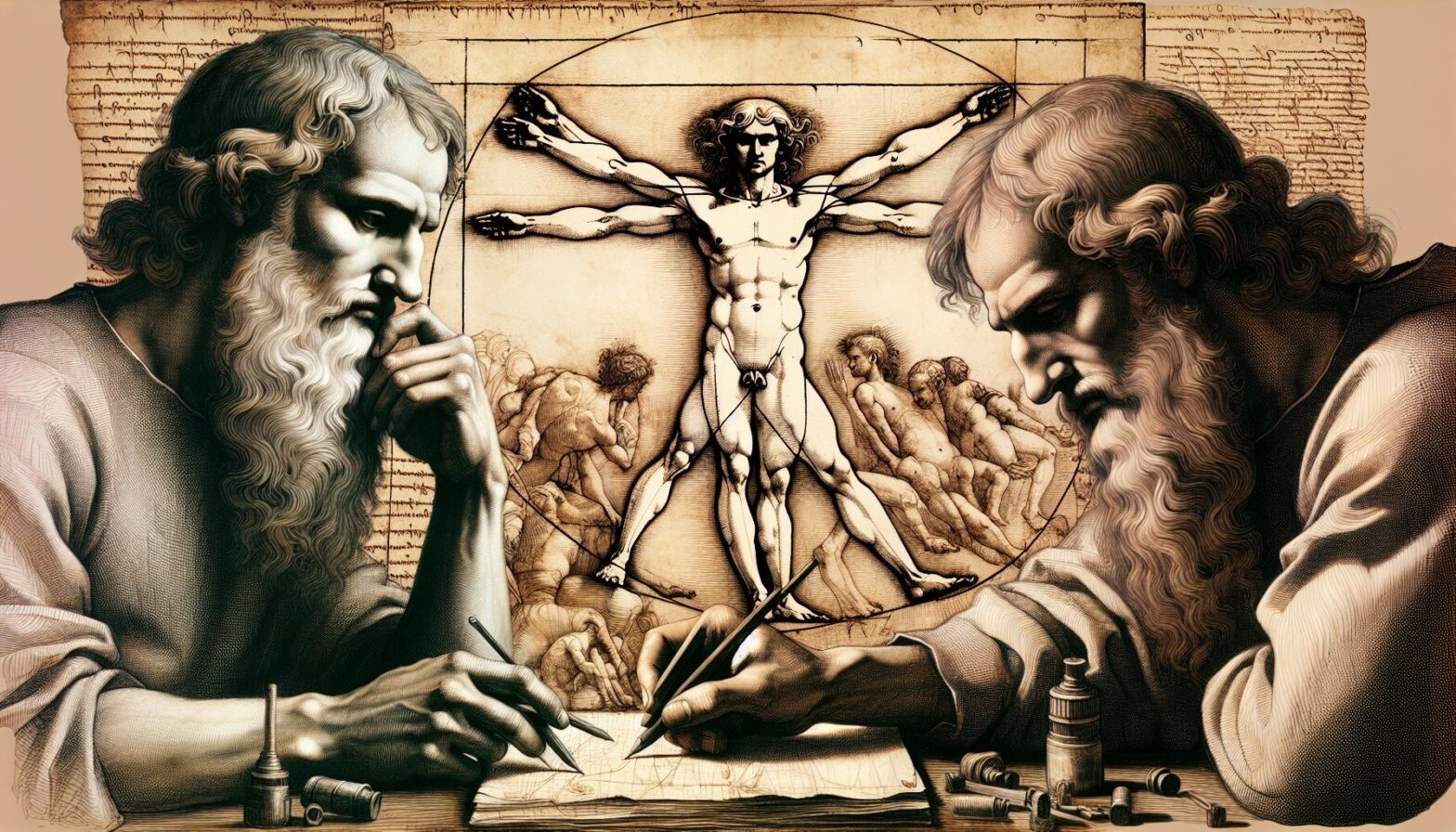
Welcome to today’s deep dive into the wild world of Artificial Intelligence in creative arts. It feels like we’re living through a sci-fi novel right now. I won’t even try to hide my enthusiasm—I feel like I’m watching one of those moments in history where technology and creativity collide in completely unexpected ways. Seriously, was Michelangelo a software developer in a past life? Let’s jump right in.
The Rise of Algorithmic Art
Here’s the thing: Art is subjective, limitless, and packed with human emotion and interpretation. Enter AI—traditionally the domain of cold computations and logic. Armed with nothing but hypothetical paintbrushes and complex algorithms called Generative Adversarial Networks (GANs), AI has crashed the party of imagination.
If you’re wondering why GANs matter, picture these algorithm “fraternal twins” playing tug-of-war. The generator creates art and the discriminator judges it. Over time, this back-and-forth process refines pieces of art through massive datasets, resulting in visual works that often look exactly like something a human created.
Remember last year when AI-generated paintings, trained on Van Gogh’s work, actually sold for ridiculous prices? The arguments that auction sparked could only be matched by watching human creativity wrestle with AI’s alien brushstrokes in real time.
The Soulful Machine: Creativity Beyond Imitation
Copying old masters might be interesting, but AI’s real breakthrough goes way beyond just recreating past artistic styles. I keep wondering whether AI can truly be creative, whatever “creativity” actually means. Ask any over-caffeinated artist working with Google’s DeepDream and they’ll tell you—the algorithm’s weird interpretation of abstract ideas has produced some seriously surreal and unexpected visual experiences.
Even text-based tools are now creating guitar riffs and song lyrics that actually sound good. We’re seeing AI compose music that doesn’t just mimic existing styles but creates something genuinely new and listenable.
Democratizing Creativity (But Will Algorithms Steal Artists’ Jobs?)
Here’s where things get complicated. Is AI ultimately a helpful tool or a threat to working artists? On one hand, platforms are popping up that let anyone create professional-looking art without years of training. That’s pretty amazing for accessibility.
But I can’t ignore the elephant in the room. Traditional artists are rightfully worried about AI flooding the market with cheap alternatives to their work. It’s not just about competition—it’s about the value we place on human creativity and the time artists spend developing their craft.
The democratization angle is real though. Suddenly, someone with zero artistic training can produce compelling visuals for their small business or personal projects. That’s either revolutionary or terrifying, depending on where you sit.
AI as a Collaborative Tool
Let’s talk about where this is actually working well right now. The most interesting developments I’m seeing aren’t AI replacing artists, but AI working alongside them. Digital artists are using AI to generate base concepts, then adding their own human touch and interpretation.
Think of it like having a really weird, tireless assistant who can generate hundreds of rough drafts in minutes. The artist still makes the final creative decisions, but the AI handles some of the heavy lifting in the ideation phase.
Some illustrators are using AI to break through creative blocks or explore visual directions they never would have considered. Others are incorporating AI-generated elements into larger compositions. It’s collaboration, not replacement.
The question isn’t whether AI will change art—it already has. The question is how we adapt to make sure human creativity still has value and meaning in this new landscape. Because at the end of the day, art isn’t just about technical skill. It’s about expressing something fundamentally human, and I’m not convinced algorithms can replicate that, no matter how sophisticated they become.